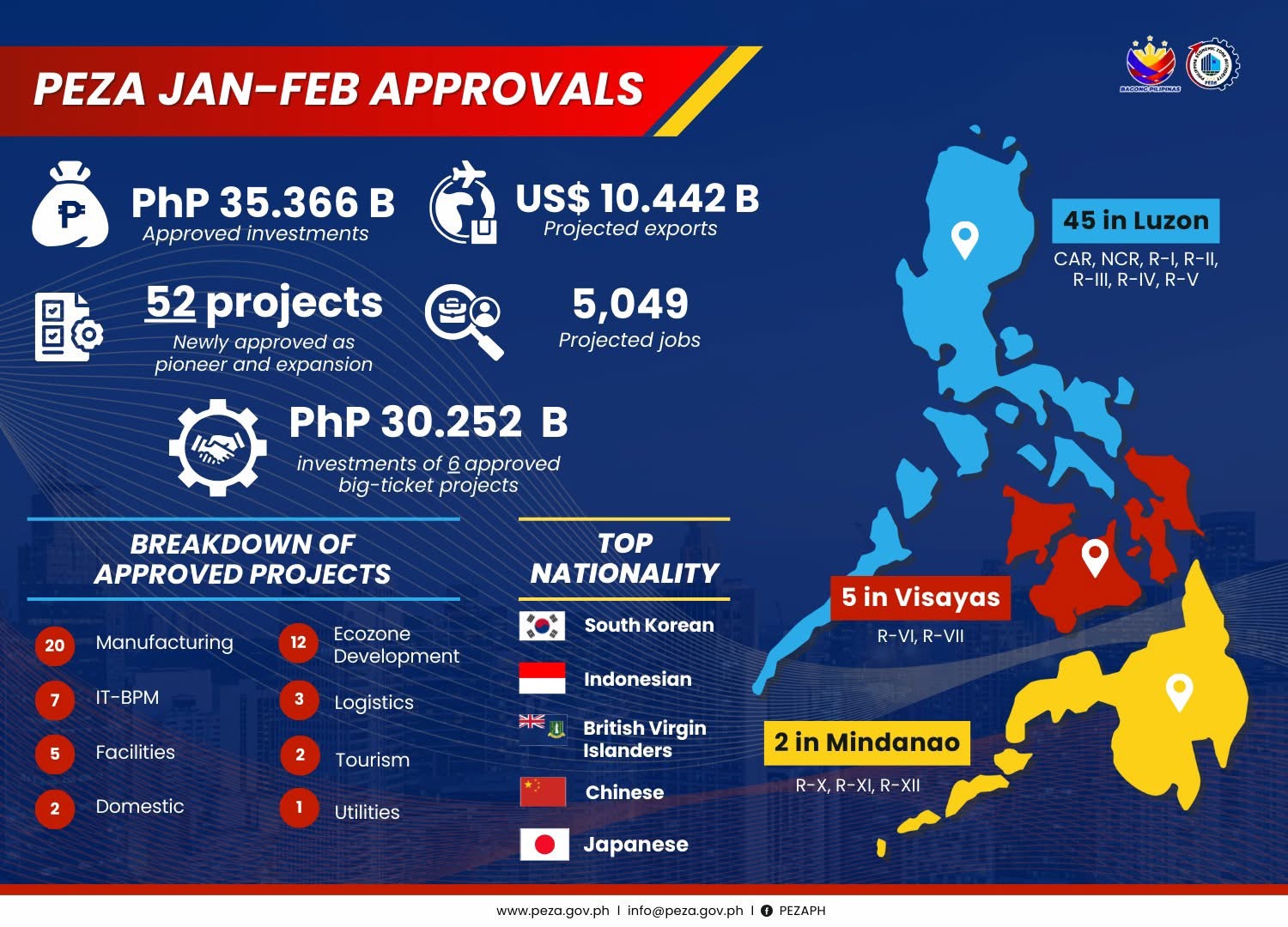
Investment approvals from the Philippine Economic Zone Authority (PEZA) rose in volume during the first two months of 2026, signaling sustained investor interest in economic zones even as the overall value of commitments declined year on year.
From January to February, the PEZA Board cleared 52 new and expansion projects worth P35.37 billion, down 33 percent from the P52.93 billion approved in the same period in 2025. Yet the number of projects increased by 33.33 percent from 39 approvals a year earlier, suggesting a broader mix of smaller or more phased investments entering the pipeline.
The approved projects are projected to generate over 5,000 direct jobs and significantly boost exports. Estimated export revenues from these investments reached USD10.442 billion, a dramatic surge from USD274 million recorded during the same two-month window last year.
PEZA attributed the trend to a more diversified investor base, with leading sources of new commitments coming from South Korea, Indonesia, the British Virgin Islands, China, and Japan. The 52 approvals involve 40 locator companies across industries including export manufacturing, information technology and business process management (IT-BPM), logistics, and facilities development, alongside 12 ecozone development projects.
February alone accounted for the bulk of activity. The PEZA Board approved 34 projects valued at P22.505 billion, which are expected to produce USD10.382 billion in exports and create 4,044 direct jobs. The mix includes 13 export manufacturing ventures, five IT-BPM projects, five facilities developments, two logistics companies, one domestic market enterprise, one tourism project, and seven ecozone developments.
Geographically, the investments will be spread across Metro Manila, CALABARZON, Central Luzon, Cagayan Valley, Central and Western Visayas, and the Ilocos Region.
Notably, several large ecozone ventures in Bulacan, Pampanga, and Tarlac worth a combined P18.367 billion underscore a continuing shift of industrial expansion beyond the capital region.
While headline investment values softened, the rising project count suggests steady investor confidence and widening sector participation within the country’s economic zone ecosystem.