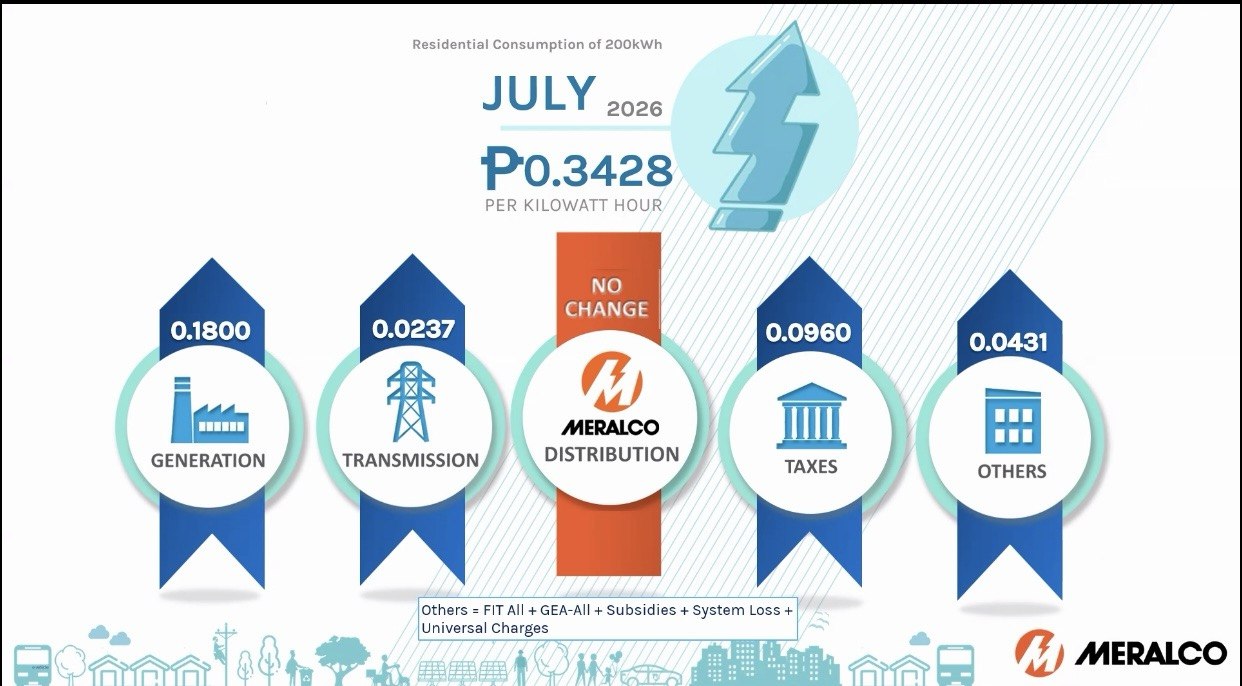
Electricity bills are climbing again in July as higher fuel costs, tighter power supply and increased taxes combined to drive up power rates, underscoring the Philippines’ continued exposure to global energy price swings and supply disruptions.
Manila Electric Co., the country’s largest power distributor by sales, said residential electricity rate will rise by P0.3428 per kilowatt-hour to P14.8261 per kWh this month from P14.4833 per kWh in June.
For a household consuming 200 kWh, the adjustment means paying about P69 more this month.
The biggest contributor to the rate hike was the generation charge, which increased by P0.1800 per kWh to P9.2504 per kWh after the scheduled month-long shutdown of the Malampaya natural gas facility forced the Sta. Rita and San Lorenzo power plants to switch to costlier imported liquefied natural gas (LNG).
The increase rippled through the power supply chain. Charges from First Gas/Prime CoreGen climbed to P10.6489 per kWh, while rates under power supply agreements, which account for 72 percent of Meralco’s electricity requirements, also rose as the continuing Middle East conflict kept global fuel prices elevated.
Spot market prices also moved higher, reaching P8.0337 per kWh after Luzon’s electricity demand hit a record 14,534 megawatts on May 28, tightening supply and pushing wholesale prices upward.
Consumers were likewise hit by higher taxes. The shift to imported LNG subjected fuel purchases to the 12 percent value-added tax, unlike Malampaya gas, which is VAT-exempt, adding P0.0960 per kWh to electricity bills.
Meralco noted that its distribution charge has remained unchanged since it was reduced in August 2022. The Energy Regulatory Commission also extended the suspension of the P0.0371 per kWh Green Energy Auction Allowance until August, helping soften what would have been a steeper increase.
The latest adjustment highlights a familiar challenge for the power sector. When Malampaya supply is interrupted, the country leans more heavily on imported fuel, exposing consumers to volatile global energy markets and reinforcing the urgency of expanding more stable and diversified power sources.