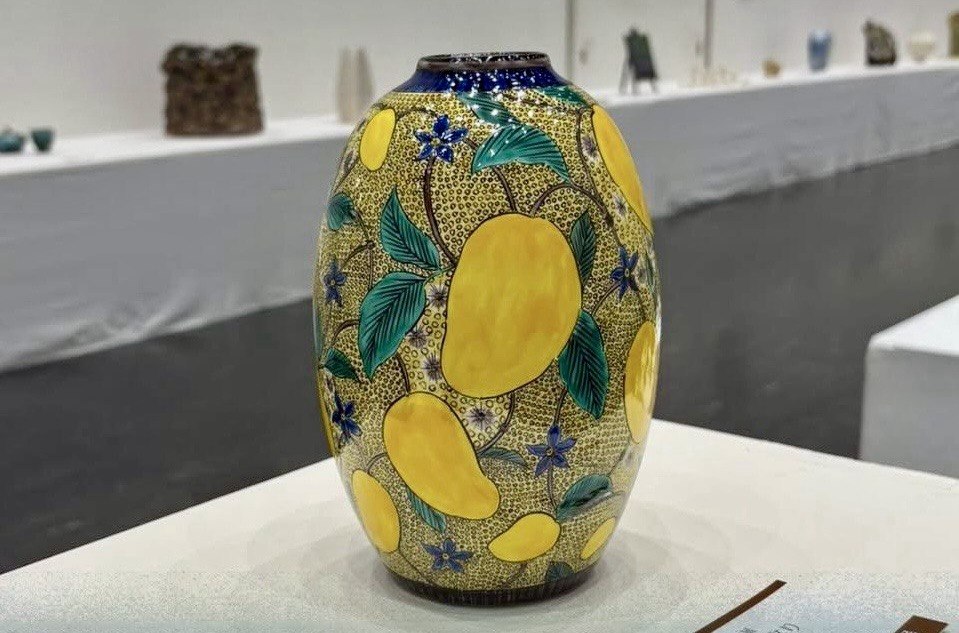
The Philippine mango has long been celebrated for its sweetness. Now it has found a different kind of distinction, becoming the muse for an award-winning Japanese porcelain artwork that captures how culture, much like trade, often flourishes through unexpected exchanges.
As the Philippines and Japan commemorate the 70th anniversary of the normalization of diplomatic relations, the Philippine Embassy in Tokyo said Japanese porcelain painter Tomoko Sumi’s latest honor offers a vivid reminder that diplomacy is not confined to conference tables. Sometimes, it takes shape on porcelain.
Sumi’s ceramic work, Youkou no Minori (Sunlight Fruit), received the Best New Artist Award and the ANA Crowne Plaza Hotel Sapporo Award at the 54th Hokkaido Ceramic Open Exhibition, held from July 21 to 26 at the Sapporo Citizens Gallery.
Inspired by her frequent visits to the Philippines, Sumi translated the warm glow of Philippine mangoes into the centuries-old Japanese tradition of Kutani porcelain painting, a craft renowned for its vivid overglaze colors and intricate detail.
“Watching the mangoes glowing beneath the brilliant midday sun and the warm golden light of sunset, I came to feel that they were like little suns themselves,” Sumi said. “I wanted to express their warmth, vitality, and beauty through the traditional art of Kutani porcelain painting.”
The result is more than a still life. It is a dialogue between two cultures, pairing one of the Philippines’ most recognizable agricultural icons with one of Japan’s most enduring artistic traditions.
The Philippine Embassy described the artwork as “a fitting tribute to the boundless possibilities of the deepening Philippines-Japan friendship.”
Its recognition also comes as both countries seek to deepen agricultural cooperation. Philippine and Japanese officials recently discussed revisions to mango export work plans during the 2nd Philippines-Japan Joint Committee on Agriculture and Fisheries meeting in Tokyo, while Philippine mangoes continue to enjoy strong demand in Japan, particularly as premium dried fruit products.
With more than 20 years of experience teaching porcelain painting, Sumi continues to hold workshops and exhibitions in both countries. Her latest work suggests that the Philippine mango has become more than an export. It has become an artistic bridge, proving that shared appreciation can travel just as far as commerce.