The Philippines is emerging as one of Southeast Asia’s fastest-growing beauty and personal care markets, with consumers increasingly trading old-school whitening formulas for science-backed skincare tailored to the country’s tropical climate.
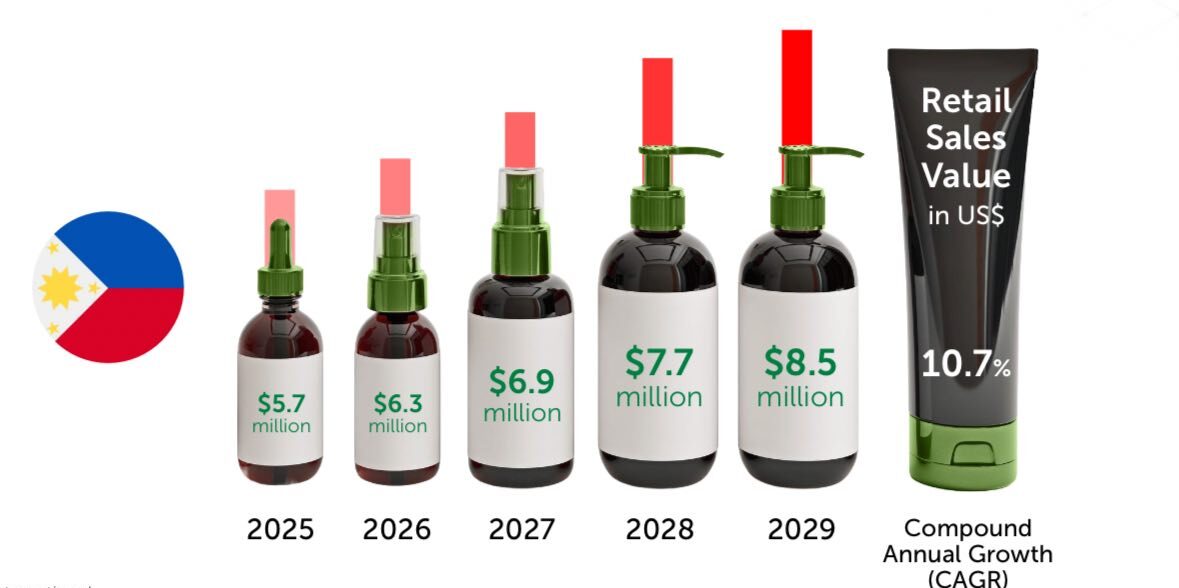
The study “APAC Beauty: Rewriting Trends with Science and Local Insight” projects Philippine cosmetics retail sales to grow at a 11 percent compound annual growth rate through 2029. Sales are expected to rise from USD5.7 million in 2025 to USD8.5 million by 2029.
That puts the Philippines ahead of most major Southeast Asian markets on growth, although Malaysia is forecast to expand faster at 14 percent annually. Indonesia, the region’s biggest beauty market, is expected to grow 10 percent, while Thailand is seen expanding 8 percent.
The numbers point to a market where growth is increasingly being shaped not simply by beauty aspirations, but by consumers becoming more discerning about what they put on their skin.
Premium, ingredient-led products are gaining traction, particularly those designed to work in hot and humid conditions.
“People want light gel or serum formats. As the Philippines is a tropical country, oily or greasy products don’t work here,” said Pearl Valenton, technical services department manager at Refinette.
Euromonitor data cited in the study show rising interest in niacinamide, vitamins B3 and B5, ceramides, peptides, retinol, and retinaldehyde. Familiar botanicals such as coconut oil, papaya, calamansi, guava, and cica are also finding space alongside laboratory-developed ingredients.
The shift is particularly notable in brightening, traditionally a major Philippine beauty category. Consumers are increasingly gravitating toward gentler, evidence-based formulations rather than harsher chemical whitening products.
For beauty companies, the opportunity is therefore less about selling another global trend and more about localizing it. Products that combine credible science, tropical-climate performance, and ingredients consumers recognize could have an edge in a market becoming more sophisticated by the serum dropper.
Across Asia-Pacific, South Korea remains synonymous with innovation and China with manufacturing scale. Southeast Asia, however, is increasingly becoming the region where localization itself becomes a competitive advantage.