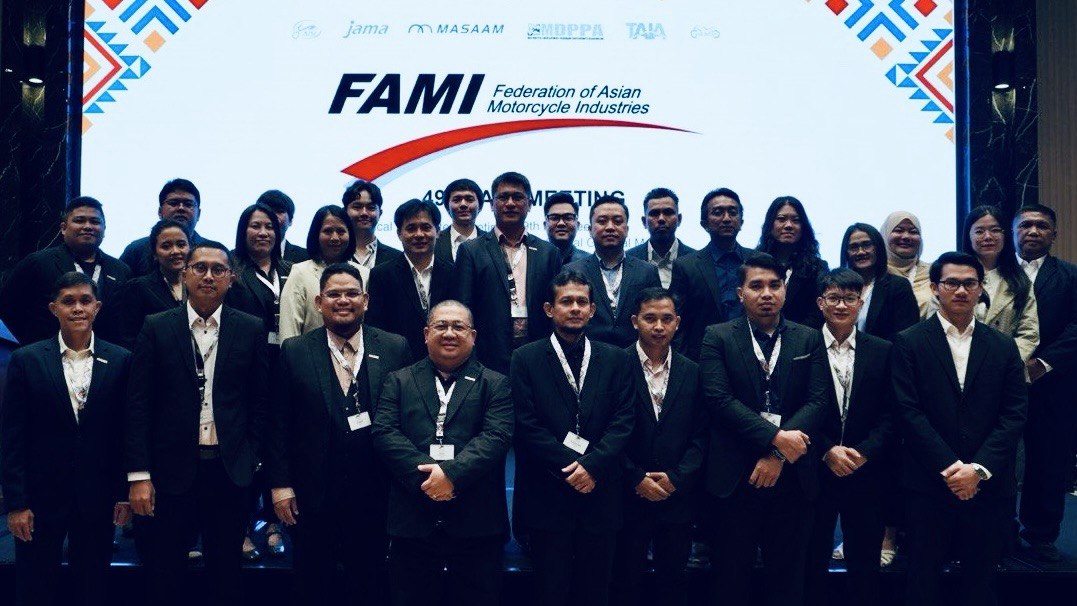
The Philippine motorcycle industry is taking a bigger role in shaping ASEAN standards and regulations after the Motorcycle Development Program Participants Association (MDPPA) was elected to chair the region’s key motorcycle technical committee through 2029.
The MDPPA will chair the ASEAN Automotive Federation’s Technical Committee for Motorcycle (AAF-TC5) for three years through March 2029, giving the Philippine industry a stronger voice in shaping regional motorcycle policies.
The appointment took effect during the Federation of Asian Motorcycle Industries gathering in Boracay in March 2026.
Representing the MDPPA as AAF-TC5 chairman is Alexander Cumpas of Kawasaki Motors (Phils.) Corp., with MDPPA Secretary General Gilmar De Castro serving as secretariat.
The committee brings together motorcycle industry associations from the Philippines, Indonesia, Malaysia, Thailand, and Vietnam, with guidance from the Japan Automobile Manufacturers Association.
Its work may sound technical, but the issues are anything but. AAF-TC5 participates in discussions with the ASEAN Automotive Product Working Group and the Private Public Forum, providing industry input on standards and regulations affecting motorcycle manufacturers and markets across Southeast Asia.
For an industry built around mobility, fewer regulatory roadblocks can mean smoother movement of both products and ideas.
“Motorcycle markets across ASEAN share many opportunities and challenges especially with regard to harmonization and standardization,” Cumpas said.
“We are positive that this cooperation allows us to learn from one another while working toward approaches that support the continued development of the industry.”
The leadership role comes as motorcycles remain a major part of transportation across ASEAN, while manufacturers face growing pressure to address emissions, safety, technology, and other sustainability concerns.
The Philippine market itself remains resilient. MDPPA reported 939,528 motorcycle sales in the first half of 2026, up 3.58 percent from 907,054 units a year earlier.
De Castro said closer regional cooperation would be increasingly important as the sector evolves.
“We look forward to working closely with our regional counterparts, sharing knowledge and representing the interests of the Philippine motorcycle industry as we contribute to the responsible and sustainable growth of mobility across ASEAN,” he said.
For the Philippines, the three-year chairmanship gives the local motorcycle industry a stronger hand in discussions that could shape standards and regulations across one of the world’s most motorcycle-dependent regions.