San Miguel Aerocity Inc. (SMAI), developer of the New Manila International Airport (NMIA), on Thursday confirmed the project incorporates robust, long-term flood mitigation engineering designed to protect both the airport and surrounding towns from Bulacan’s well-documented flooding risks—while clarifying the airport is not the cause of recent floods.
In response to online claims linking NMIA to flooding after weeks of heavy rain, SMAI stated those assertions lack hydrological data, technical analysis, or verified expert backing. “NMIA did not cause Bulacan’s flooding. This is a problem the province has faced for generations. Our responsibility is to build the airport for these conditions, and ensure our work never makes flooding worse,” the company said.
Bulacan’s longstanding flooding stems from its low-lying coastal terrain, heavy rainfall, upstream river flows, limited river capacity, land subsidence, and rising sea levels—factors well established long before the airport was planned.
The project’s flood design rests on over eight years of intensive research and technical studies, beginning in 2018 with global hydrology specialist DHI. The team analyzed river systems, coastal water movement, historical typhoons, storm surges, and land subsidence—including how site development would affect drainage for nearby and upstream areas.
A 2019 DHI flood assessment identified the need for improved water flow through engineered channels. In 2021, global engineering firm Mott McDonald consolidated all models to meet International Finance Corporation (IFC) and international lender standards. Long-term subsidence data and climate projections through 2100 determined the airport platform must be raised between 3.85 meters and 5.50 meters above mean sea level at its center.
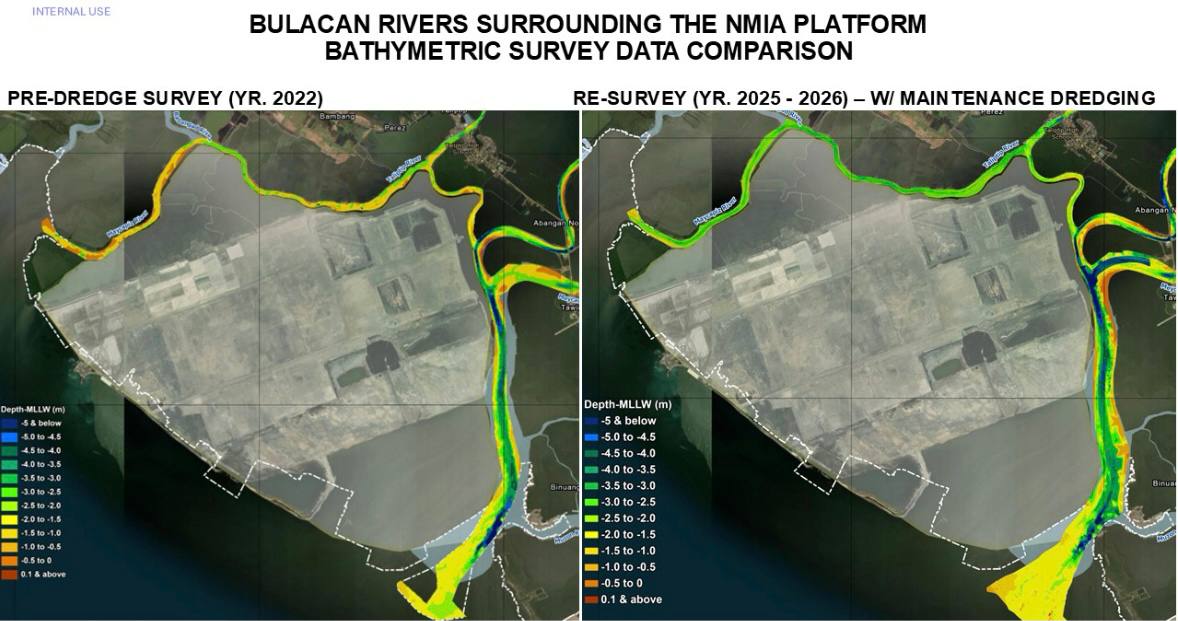
As construction began, Dutch marine engineering leader Boskalis and DHI refined the plan: instead of wide-scale river widening that would harm land and mangroves, they chose to deepen riverbeds while narrowing their base to maintain target flow rates. This solution was applied to three critical waterways: the Maycapiz-Talipit (Alipit), Santa Maria, and Meycauayan rivers.
From 2022 to 2024, through its Better Rivers PH initiative, San Miguel Corporation (SMC) removed more than 1 million metric tons of silt and waste from those three rivers—achieving the exact depth and width needed to boost water flow to Manila Bay—at no cost to the government. The effort has since expanded provincewide; as of August 18, 2026, over 4.3 million metric tons of debris and silt have been cleared across Bulacan’s major river systems. Regular maintenance remains a permanent commitment, part of SMAI’s duty to the public ahead of the airport’s eventual transfer to government ownership.
SMAI also confirmed NMIA is not a reclamation project. It is being built on existing, titled land in Bulakan town—long used as fishponds and already prone to repeated flooding—where the site’s natural conditions were fully considered during selection. The location offers the large, contiguous space required for a world-class international gateway and future expansion, while staying accessible to Metro Manila and connected to Luzon’s expressway network—capacity that the existing Ninoy Aquino International Airport (NAIA) can no longer provide.
The company emphasized that NMIA’s flood protections are separate from Bulacan’s broader, province-wide flood management needs. The entire region sits within an interconnected watershed; upstream development, land subsidence, and rising seas all combine to create a complex issue that no single project can solve alone. Low-lying areas even experience flooding at high tide without rain.
“Protecting the airport and nearby communities, and solving Bulacan’s larger flooding problems, are two different challenges,” SMAI explained. “We can engineer NMIA to withstand site conditions and minimize its footprint.
But safeguarding the whole province requires looking at the entire system—from upstream rainfall to river capacity to coastal drainage.”
SMC will continue dredging and maintenance work, but notes severe weather may demand additional public infrastructure such as wider channels, dikes, floodgates, and pumping stations across the region. SMAI remains committed to all environmental and flood-resilience obligations, and will continue working with national and local government to strengthen flood protection across Bulacan—for the airport, for nearby towns, and for every commuter who will rely on this vital gateway.