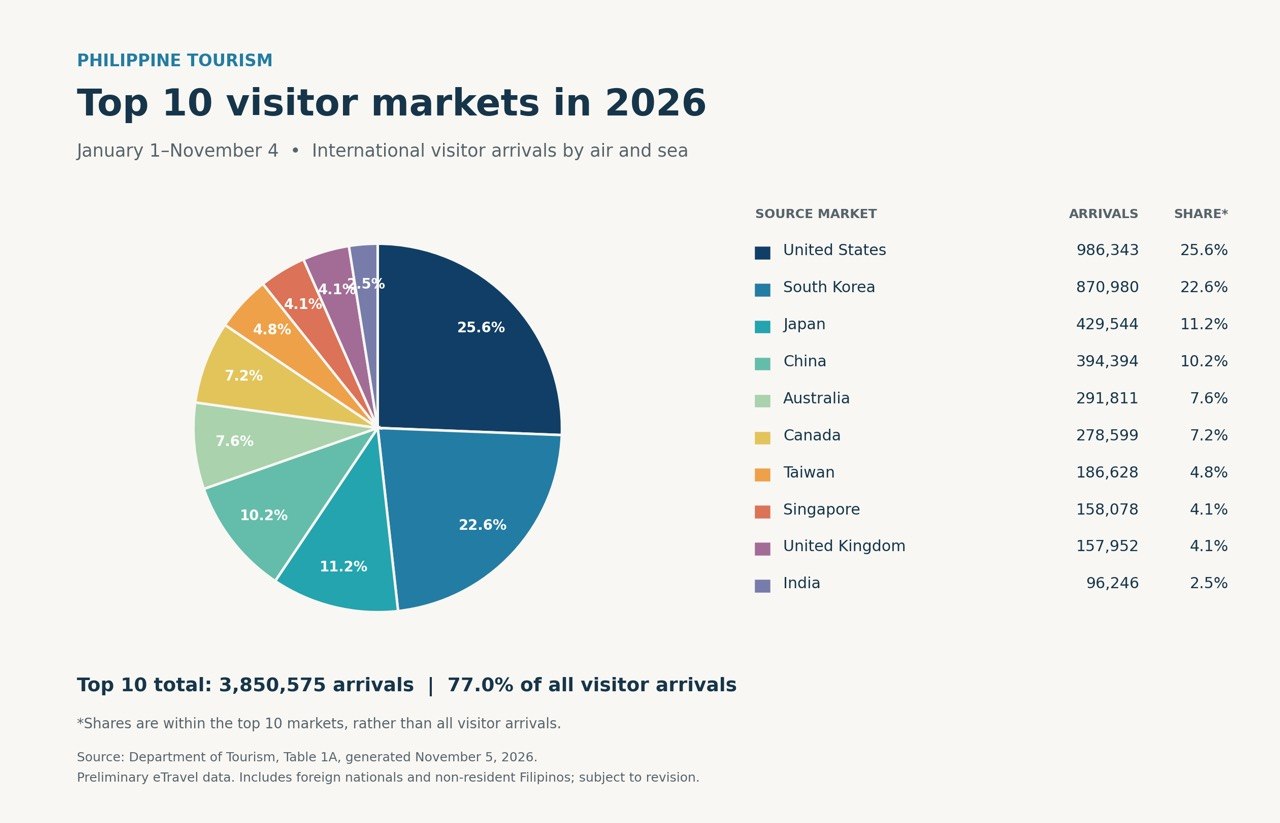
Foreign tourist arrivals in the Philippines surpassed five million as of November 4, growing 3.74 percent from 4.82 million in the same period last year, with a sharp rebound in Chinese visitors helping offset declining arrivals from South Korea.
Department of Tourism (DOT) data showed the US remained the country’s biggest source market, while China climbed to fourth place from sixth after arrivals surged nearly 70 percent, reflecting stronger demand following the introduction of visa-free entry.
Air arrivals accounted for 4.96 million, or 99.2 percent of the total, highlighting the importance of airline connectivity in sustaining the country’s tourism recovery. The remainder arrived by sea.
The US led the source markets with 986,835 visitors, up 7 percent from 920,950 a year earlier.
South Korea ranked second with 870,820 arrivals, although this was 17.71 percent lower than the previous year’s 1.06 million, pointing to continuing weakness in the country’s largest traditional Asian tourism market.
Japan placed third with 429,544 visitors, up 1.16 percent from 424,602, while China recorded the strongest growth among the five leading markets.
Chinese arrivals jumped 69.78 percent to 394,384 from 232,299, lifting the market to fourth place. The increase comes amid efforts to make Philippine travel more accessible to Chinese tourists through visa-free entry arrangements.
Australia rounded out the top five with 291,811 visitors, compared with 268,965 a year earlier.
Tourism Secretary Dita Angara-Mathay described the growth as steady but said the industry still had considerable room to improve.
Speaking at the 40th Confederation of Asia-Pacific Chambers of Commerce and Industry conference, she identified high fuel costs and airfares as continuing constraints on travel across the region, while emphasizing tourism’s wider economic contribution.
“Every visitor requires an interconnected range of services and infrastructure,” Mathay said, citing accommodation, transportation, airports, water facilities, digital connectivity and restaurants.
She also urged businesses to look beyond leisure tourism and recognize opportunities in corporate travel, conventions and site inspections, which can generate commercial activity and encourage investment.
“Tourism is not just about leisure travel,” she said. “It brings people and businesses together and often opens the door to investments and commercial relationships.”
The latest arrivals figures point to a modest expansion in Philippine tourism, but also expose an uneven recovery across source markets. Stronger Chinese demand and continued growth from the United States and Australia have helped lift arrivals, although the contraction in South Korean visitors underscores the need to broaden market growth and strengthen the country’s competitiveness as a regional destination.