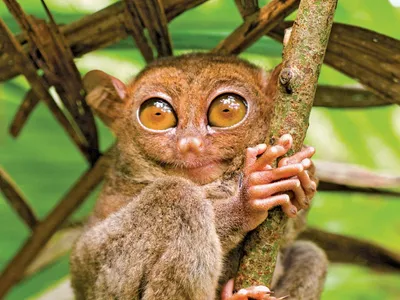
If you think city life is stressful, try being a wide-eyed, bug-eating primate barely the size of a fist, living next to roads, construction, and the occasional chainsaw. Meet the Philippine tarsier, now confirmed to be quietly surviving in the middle of urban Tacloban.
In a recent study by researchers from the University of the Philippines Tacloban, scientists documented nine Philippine tarsiers (Tarsius syrichta) across three forest patches in the city. This marks the first time this famously shy creature has been scientifically recorded in an urban environment. The findings, published in the April issue of the Philippine Journal of Science, suggest that even highly-urbanized areas may still harbor pockets of surprising biodiversity.
While traffic honks and buildings rise, these nocturnal hunters continue clinging to branches and searching for prey.
The tarsier, known for its oversized eyes and remarkable ability to rotate its head nearly 180 degrees, is one of the least studied primates in the world. It is also a strict carnivore. Instead of fruit, it feeds on insects, small lizards, and frogs. Its diet may be small, but its role in the ecosystem is significant.
Finding them in Tacloban is both encouraging and concerning. Tarsiers usually prefer dense and undisturbed forests where thick vegetation provides both food and shelter. In the city, researchers observed clear signs of pressure such as habitat loss, timber poaching, and human activity. The tarsiers are surviving, but conditions remain far from ideal.
This suggests a level of resilience. The species appears capable of adapting to fragmented green spaces scattered across urban areas. However, resilience has limits. Continued expansion of roads, housing, and infrastructure may eventually reduce these habitats beyond recovery.
The conservation status of the Philippine tarsier has shifted over the years, partly because of limited data. This new research adds valuable insight, especially for Leyte, where fewer studies have been conducted compared to more well known areas like Bohol.
The lesson is simple. Cities are not only made of concrete. They can still support wildlife if natural spaces are protected. Safeguarding forest patches, enforcing environmental laws, and involving local communities can help ensure that these animals continue to survive.
If a creature this small can persist in a growing city, then it deserves a real chance to endure.