The Philippines’ export sector is proving surprisingly resilient in an increasingly uncertain global economy, posting its 16th straight month of growth and giving trade officials fresh reason to double down on programs aimed at helping local exporters compete abroad.
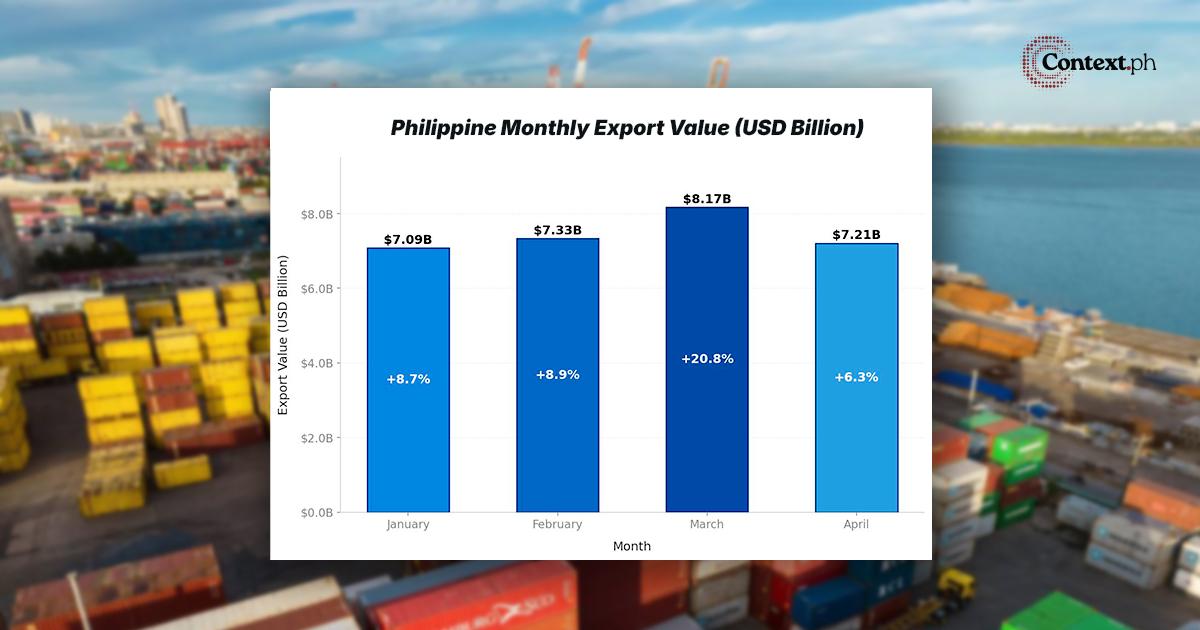
Preliminary data from the Philippine Statistics Authority showed merchandise exports rose 6.3 percent year-on-year to USD7.21 billion in April, extending a growth streak that has now lasted well over a year. For the first four months of 2026, export earnings reached USD29.93 billion, up from USD26.93 billion a year earlier and the strongest January-to-April performance in more than four years.
The numbers offer a bright spot for an economy facing external headwinds ranging from geopolitical tensions to volatile energy prices and shifting trade patterns.
Trade Secretary Cristina Roque said the sustained expansion reflects ongoing efforts to improve the competitiveness and market readiness of Philippine exporters as international trade becomes increasingly demanding.
The familiar engine of growth remained electronics, which generated USD3.44 billion in export revenues and accounted for nearly half of the country’s total exports in April.
Demand for components used in consumer electronics, telecommunications equipment, artificial intelligence applications, and Internet of Things technologies continued to underpin the sector’s performance.
But the story was not solely about semiconductors.
Machinery and transport equipment posted the fastest growth among major export categories, while coconut oil and other coconut-based products benefited from rising global demand for food ingredients and plant-based alternatives. Together, the figures suggest that the country’s export gains are becoming more broad-based.
To keep the momentum going, the Department of Trade and Industry is expanding support programs for exporters, particularly micro, small, and medium enterprises. These include training on sustainability and product traceability, digital trade and logistics workshops, halal certification assistance, and initiatives designed to open new markets.
The government’s push comes as exporters face a rapidly evolving global marketplace where compliance, sustainability credentials, and supply-chain reliability increasingly matter as much as price.
While the outlook remains positive, trade officials are keeping a close watch on geopolitical conflicts, oil price shocks, and currency fluctuations that could disrupt trade flows.
For now, however, Philippine exporters appear to be finding ways to navigate the turbulence, extending a streak that has quietly become one of the country’s strongest economic success stories.