The Philippines made progress in reducing child labor in 2025, but the gains came with a troubling twist. More Filipino children entered the workforce even as the number trapped in hazardous or exploitative work remained stubbornly high.
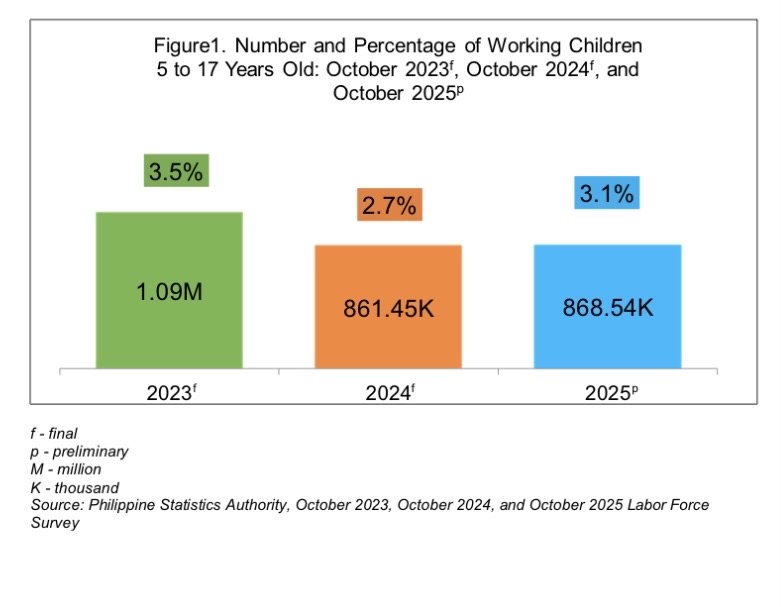
Data from the Philippine Statistics Authority showed the number of working children aged 5 to 17 rose to 868,540 in 2025 from 861,450 a year earlier, reversing part of the sharp decline from 1.09 million in 2023. Their share of the country’s child population also climbed to 3.1 percent from 2.7 percent.
The rise suggests that while fewer children are performing the worst forms of labor, economic pressures continue to push many into work.
Child labor, defined under Philippine law as hazardous work or excessive working hours that threaten a child’s health, safety, or development, affected 513,650 children in 2025. That was higher than the 509,160 recorded in 2024 but lower than the 678,360 reported in 2023.
The composition of child labor also tells a familiar story. Nearly three out of every four child laborers were boys, while four out of five were between 15 and 17 years old, indicating that older children continue to bear the burden of supplementing household incomes.
Where children work also matters.
The services sector employed the largest share of working children at 48.7 percent, followed by agriculture with 41.2 percent. But once work turns hazardous, agriculture dominates. Nearly two-thirds, or 65.5 percent, of all child laborers were found in farms, fisheries, and related activities, far exceeding the 25.8 percent in services and 8.7 percent in industry.
Most working children logged no more than 20 hours a week, but the share putting in longer workweeks continued to rise, hinting at growing economic demands on young workers.
The figures underscore a sobering reality. Fewer children may be enduring the worst forms of labor, but more are still clocking in instead of simply growing up.