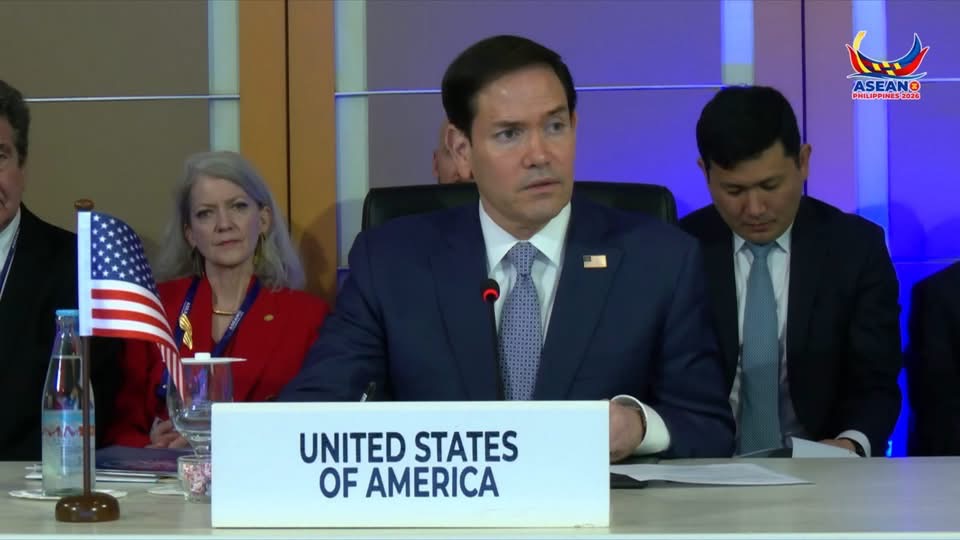
The US is tying regional security to economic resilience in Southeast Asia, using the ASEAN Post-Ministerial Conference in Manila to reaffirm its Indo-Pacific commitment while linking Middle East stability to the protection of global trade routes.
US Secretary of State Marco Rubio said Washington’s position on the Strait of Hormuz is rooted in the broader principle of freedom of navigation, warning that disruptions in one of the world’s most important maritime chokepoints could have consequences far beyond the Middle East.
Rubio said the US remains open to diplomacy with Iran but warned that continued violations of commitments would carry consequences. He argued that allowing any country to control or restrict access to an international waterway would create a precedent that could eventually threaten trade flows in other strategic regions, including the Indo-Pacific.
“The global economy is threatened” if freedom of navigation is undermined, Rubio said, emphasizing that open sea lanes have supported international commerce for more than a century.
Against that backdrop, Washington moved to deepen its economic engagement with ASEAN, announcing $2.5 billion in strategic investments across Southeast Asia. The package will be complemented by an additional $1.5 billion mobilized through the US International Development Finance Corporation for aviation infrastructure, energy security and more resilient supply chains.
The US also pledged nearly $130 million in demining assistance and expanded cooperation in areas considered critical to future economic competitiveness, including liquefied natural gas, power grid modernization, civil nuclear energy and critical minerals.
Rubio described Southeast Asia as the “engine of economic growth” in the 21st century, saying ASEAN’s prosperity is closely tied to US strategic interests.
For the region, the announcements come as governments seek to diversify supply chains, strengthen energy security and attract investment amid geopolitical uncertainty. The Philippines, hosting the ASEAN meetings, has been positioning itself as a key partner in areas ranging from infrastructure and logistics to digital transformation.
The latest commitments reflect Washington’s effort to pair security guarantees with economic engagement, reinforcing its message that a stable Indo-Pacific requires both open trade routes and stronger regional partnerships.