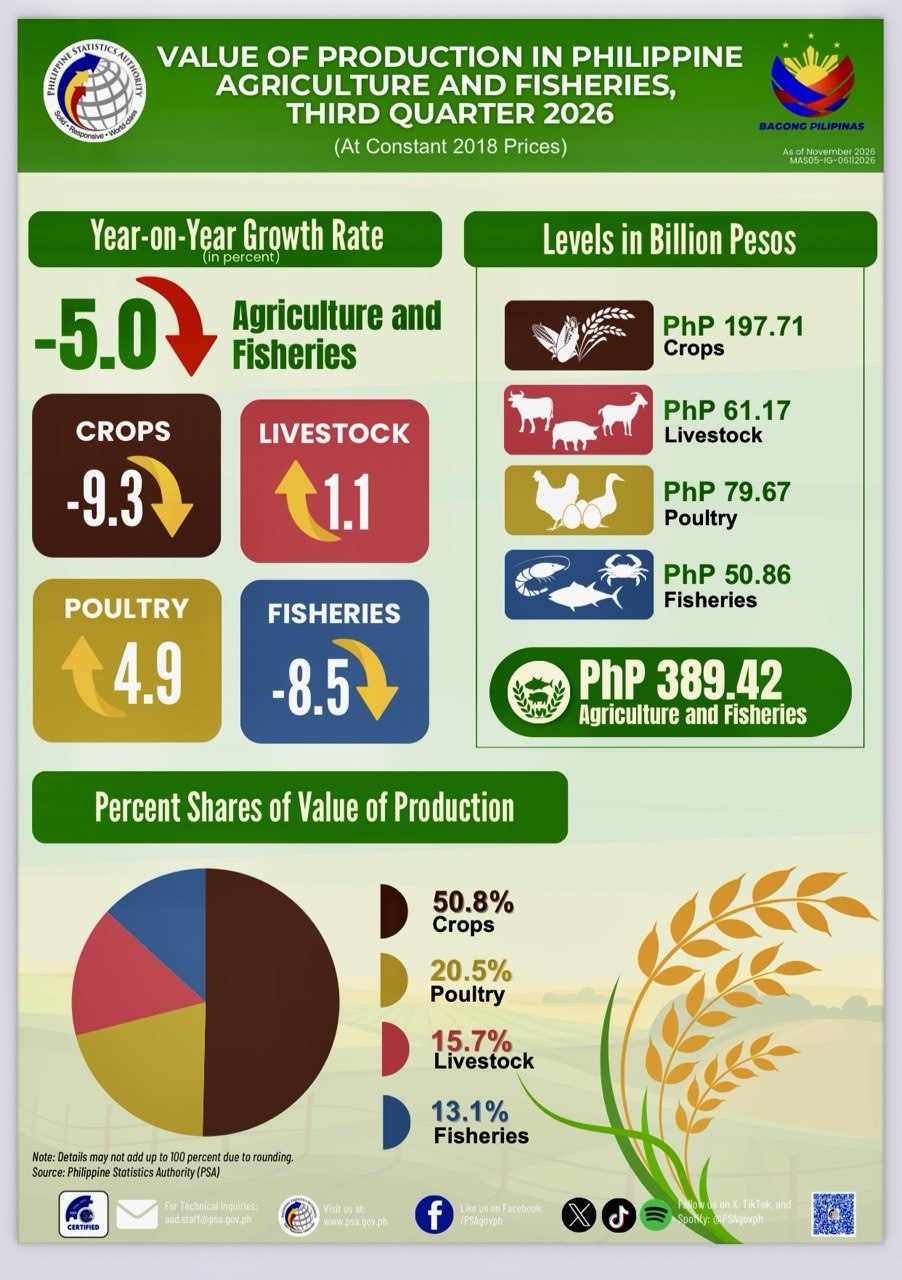
A sharp contraction in palay and corn production dragged Philippine agriculture and fisheries output down 5 percent in the third quarter of 2026, outweighing gains in livestock and poultry and underscoring the uneven recovery across the country’s food-producing sectors.
The value of agricultural and fisheries production reached P389.42 billion at constant 2018 prices, down from the same period last year, as declines in crops and fisheries offset growth in animal production, the Philippine Statistics Authority (PSA) reported.
Higher costs of fertilizer, other farm inputs and logistics due to the crisis in the Middle East, and damage caused by flooding spawn by Habagat undermined farm production.
Crop production, which accounted for 50.8 percent of the sector’s total output, fell 9.3 percent to P197.71 billion. Palay and corn saw the steepest declines, with production plunging 17.8 percent and 17.4 percent year-on-year, respectively.
The weakness in the two staple crops weighed heavily on overall agricultural performance, given their substantial contribution to farm output and the country’s food supply.
Fisheries also remained a drag, with production value declining 8.5 percent to P50.86 billion, representing 13.1 percent of total agriculture and fisheries output.
The contractions contrasted with continued expansion in livestock and poultry, which provided some cushion against the weakness in crops and fisheries.
Livestock production increased 1.1 percent to P61.17 billion, accounting for 15.7 percent of total output. Hog production, the sector’s biggest component, grew 1.9 percent during the period.
Poultry delivered the stronger performance, with production value rising 4.9 percent to P79.67 billion, equivalent to 20.5 percent of the agriculture and fisheries total.
The latest figures point to mounting pressure on farm production, particularly in staple crops, even as livestock and poultry continued to expand. The divergent performances highlight the challenge of sustaining overall agricultural growth while protecting food supply from production setbacks.