The Bureau of Internal Revenue (BIR) has issued fresh guidance to help businesses correctly apply revised creditable withholding tax (CWT) rules, ending months of uncertainty for thousands of large companies covered by the new regulations.
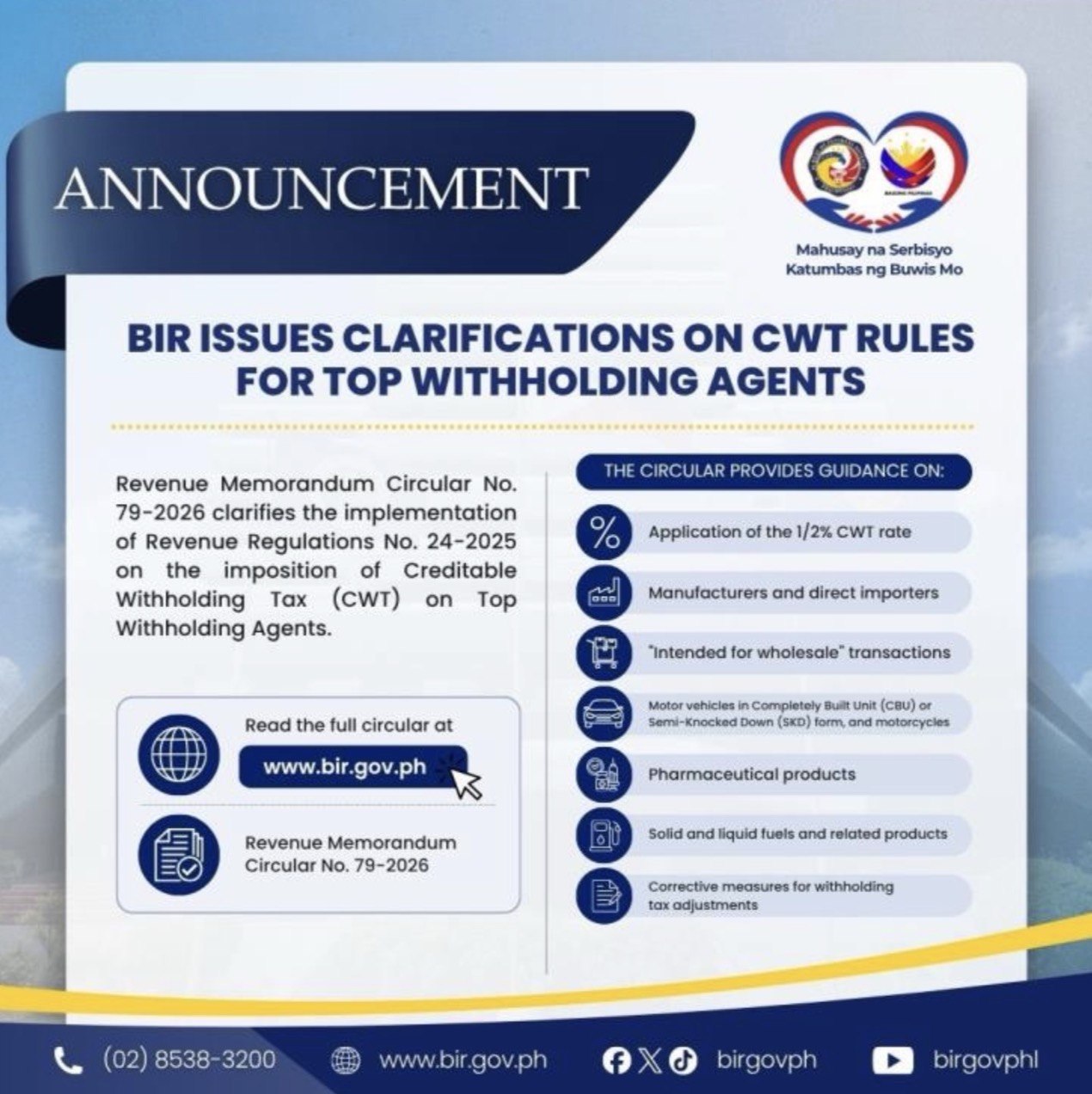
In Revenue Memorandum Circular (RMC) No. 79-2026, released Monday, the BIR clarified key provisions of Revenue Regulations (RR) No. 24-2025, which reshaped withholding tax obligations for Top Withholding Agents (TWAs), including large corporations, high-net-worth individuals and certain foreign businesses operating in the Philippines.
Under the rules, TWAs generally withhold 1 percent on purchases of goods and 2 percent on services from suppliers. However, the BIR reiterated that a preferential 0.5 percent withholding tax applies to purchases from manufacturers and direct importers of goods intended for wholesale.
The circular spells out the documentary requirements suppliers must submit to qualify for the lower rate, defines what constitutes goods “intended for wholesale” and identifies the products covered, including completely built unit (CBU) and semi-knocked down (SKD) motor vehicles, motorcycles, pharmaceutical products and solid and liquid fuels.
The BIR also outlined procedures for correcting transactions where businesses withheld the wrong tax rate, giving taxpayers a clear process for compliance.
“The issuance aims to promote the uniform implementation of RR No. 24-2025,” the BIR said, adding that the circular seeks to ensure consistent application of the revised withholding tax rules across covered transactions.
RR No. 24-2025 was issued on Sept. 25, 2025, updating decades-old withholding tax provisions under RR No. 2-98. The regulation took effect on Oct. 10, 2025, with the BIR later introducing new tax codes to support implementation.
The latest circular serves as the long-awaited implementing guide for accountants, tax professionals and businesses, reducing compliance risks and helping companies avoid costly withholding errors.
With clearer rules now in place, the BIR expects smoother compliance, more accurate tax remittances and fewer disputes over withholding obligations. The full text of RMC No. 79-2026 is available on the BIR website.