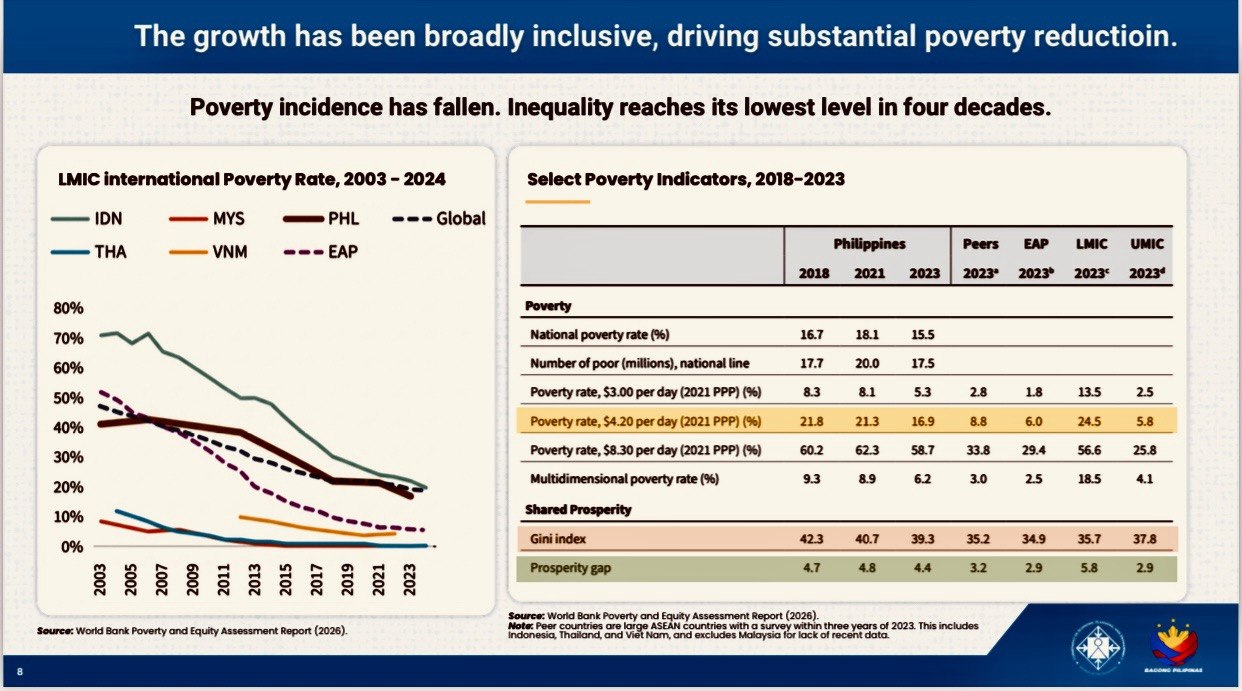
Economic growth has lifted millions of Filipinos out of poverty over the past 15 years, but many remain close enough to the poverty line to be pushed back by the next serious flood, conflict, or economic shock.
Economic Planning Secretary Arsenio Balisacan made the point Friday at a business forum organized by the Economic Journalists Association of the Philippines, offering a candid assessment of the country’s growth story and its unfinished business.
The economy has expanded by an average of 5.1 percent since 2010, driven largely by household consumption and services. That growth has raised incomes and improved income distribution, helping more Filipinos cross the poverty threshold. “But I believe that is not something that we should be happy about,” Balisacan said.
Clearly, crossing the line is not the same as putting poverty safely in the rearview mirror.
“There are two things that are driving poverty reduction. One is the increase in average incomes over the years, and the other one is also improving equality, improving the distribution of income,” Balisacan said.
Many Filipinos who have escaped poverty, he added, remain vulnerable to setbacks. A severe flood, armed conflict, a major economic disruption, or another household shock could push them back below the threshold.
That vulnerability exposes a weakness in the country’s growth model. Growth can lift people, but unless it builds stronger household incomes, better jobs, and greater economic security, some families remain precariously perched just above the poverty line.
Balisacan said the government’s challenge is therefore not merely to reduce poverty, but to make those gains durable and give families enough economic room to move further upward.
The task becomes harder as the Philippines aims to graduate into a high-income economy. Although the country is already classified by the World Bank as upper-middle income, Balisacan said it could take at least two decades to reach the next level, even assuming growth rates comparable to China and Chile, which averaged around 8 percent during their rapid development periods.
The Philippines has been particularly successful at driving consumption, he said, but has lagged in investment and exports.
That is where the next chapter of growth may have to come from.
Balisacan said industry and agriculture remain important engines, but ultimately, productivity and innovation will determine how fast the economy can move.
Consumption may get the economy moving. Investment, exports, productivity, and innovation, however, will determine how far it can go.