Making the next generation of solar cells more efficient may come down to a surprisingly simple cleanup job.
Researchers have found that washing a key surface layer with a carefully balanced solvent mixture can improve the performance and durability of perovskite solar cells, a promising technology that could complement or even compete with conventional silicon panels.
Perovskite solar cells use a thin layer of specially engineered crystalline material to absorb sunlight and convert it into electricity. Unlike traditional solar panels, which mainly rely on silicon, perovskites can be processed into very thin films and tuned to absorb different parts of the solar spectrum. They can also be paired with silicon in tandem cells to squeeze more electricity from the same sunlight.
The technology, however, has a stubborn weakness. Heat, moisture, light, and microscopic defects can degrade perovskite cells and interfere with the movement of electric charges.
The study, led by researchers from King Abdullah University of Science and Technology and the Chinese University of Hong Kong, tackled one of those problems by improving the interface between two types of perovskite. The study was published in Cell Press Blue.
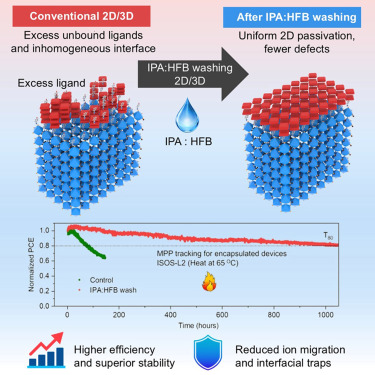
Researchers placed a thin two-dimensional, or 2D, perovskite layer over a conventional three-dimensional, or 3D, perovskite layer. The 2D layer acts somewhat like a protective skin, helping suppress defects and unwanted movement of ions.
But there was a catch. The process could leave excess organic material on the surface, creating resistance that made it harder for electric charges to escape. Washing with isopropanol alone could remove too much of the useful 2D layer.
The researchers found a sweet spot using a 25:75 mixture of isopropanol and hexafluorobenzene. The treatment removed loosely attached material while preserving the desired 2D structure and producing a more uniform surface.
The resulting solar cells reached a power-conversion efficiency of 26.10 percent. They retained about 67 percent of their efficiency after more than 7,200 hours of accelerated thermal testing and about 80 percent after more than 1,000 hours of photothermal stress.
The approach also worked with several types of organic ligands, suggesting broader potential.
There is still homework. The tests involved tiny 0.1-square-centimeter devices, so larger cells and modules will have to prove the trick works at scale.
For now, the lesson is clear. In solar technology, sometimes better performance starts with a very precise wash.