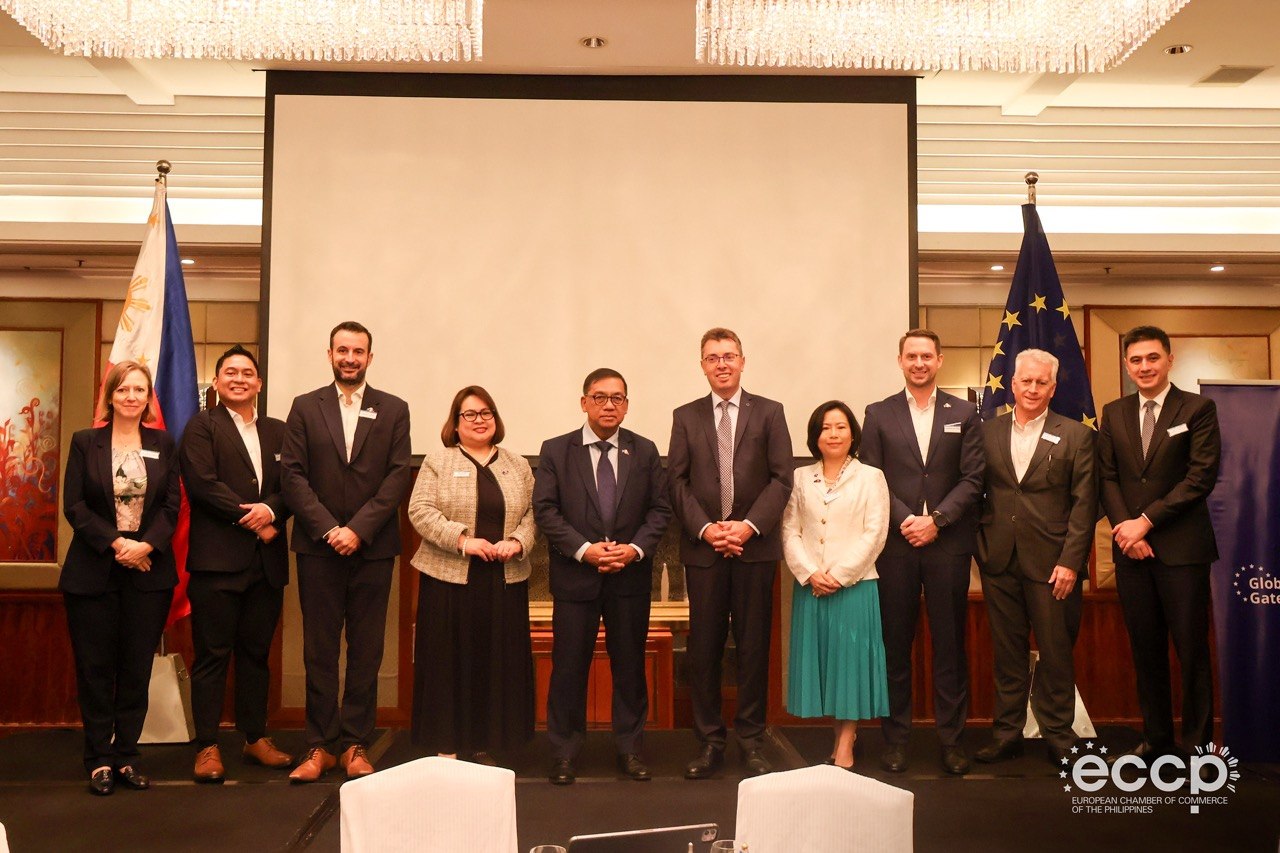
The Philippines and the European Union are advancing an artificial intelligence laboratory designed to bring research closer to market, attract investment and encourage responsible AI adoption across businesses and government.
The Department of Science and Technology (DOST) and the EU Delegation to the Philippines held a ceremonial signing for the EU–Philippines AI Lab during the European Chamber of Commerce of the Philippines’ 2026 AI Forum in Makati on October 22.
The initiative forms part of the EU’s €40 million digital cooperation package with the Philippines, equivalent to approximately P2.85 billion, under its Global Gateway strategy. It aims to strengthen technology transfer, accelerate innovation and develop a trustworthy, inclusive AI ecosystem.
DOST Secretary Renato Solidum Jr. called for a shift in how the country approaches artificial intelligence, urging industry and government to build domestic capabilities rather than rely solely on imported technologies.
“Years from now, I hope we look back on this gathering as the point where industry and government stopped viewing AI as something merely to purchase, and began treating it as a national capacity to build,” Solidum said.
EU Ambassador Massimo Santoro emphasized that developing skilled workers must accompany investment in technology, pointing to talent retention as another priority.
“We wish to build not only technology capacity but also human capacity, and of course, promoting talent retention,” he said.
The forum also explored the implications of AI for cybersecurity, data privacy and critical infrastructure protection. While AI offers new tools to strengthen digital defenses, it can also enable more sophisticated cyber threats, placing greater importance on safeguards and institutional readiness.
Discussions further highlighted the need for workforce training and closer coordination among industry initiatives covering AI, cloud computing, data management and cybersecurity.
The laboratory’s commercialization and investment goals reflect a broader challenge for the Philippines: translating research and emerging technologies into solutions that businesses and public institutions can deploy. Its impact will depend on how effectively collaboration produces market-ready applications, develops local expertise and creates opportunities for Filipino workers and enterprises.
By linking research, industry participation and skills development, the initiative seeks to position AI as a driver of innovation and economic opportunity rather than simply another technology to adopt.