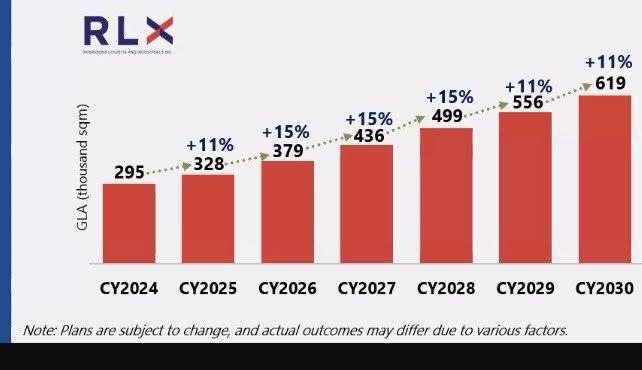
Robinsons Land Corp. (RLC) is positioning logistics as its next major growth engine, planning to more than double its industrial and warehouse footprint by 2030 as it seeks to deepen recurring income.
RLC President and CEO Kerwin Tan said the company expects its logistics portfolio to exceed 600,000 square meters of gross leasable area (GLA) by 2030, up from its current network of 15 industrial and logistics facilities.
Tan said the segment has substantial room to grow, comparing its current development stage with the Philippine office market about a decade ago.
“What we see from us in logistics is what offices were about 10 years ago,” Tan said, noting that the business is already generating attractive margins.
The expansion could also create a pipeline of assets for RLC’s real estate investment trust, RCR.
RLC can eventually inject mature logistics properties into RCR while replenishing its own development pipeline with new assets, creating a recurring cycle of development and asset transfers.
“RLC will replenish these assets. So it’s really a cycle refill that could be sustained over a long period of time,” Tan said.
RLC’s investment portfolio accounted for 72 percent of consolidated revenues in the first half, with malls, offices, hotels, and logistics providing most of its recurring income.
Tan said logistics could become the next major source of RCR asset infusions, although the timing would depend on market conditions and the maturity of individual properties.
Meanwhile, the office sector is expected to evolve rather than be displaced, with more than 70 percent of RLC’s office tenants coming from the business process outsourcing (BPO) industry.
Tan said BPO companies could eventually require more office space per employee as workplaces accommodate larger monitors, more collaborative setups, and emerging artificial intelligence-related roles. Current space allocation is about six to seven square meters per employee.
In residential, Tan said the market “has bottomed down” as developers reduced new launches and supply and demand move closer to equilibrium.
“In the next three years, I think we would go back to where we were,” he said, noting that most RLC residential buyers are end-users rather than speculative investors.
With logistics expanding, offices adapting, and residential conditions stabilizing, RLC is reshaping its portfolio around businesses that can deliver recurring income while creating new avenues for long-term growth.