The Philippines is quickly carving out a place as one of Southeast Asia’s most enthusiastic adopters of artificial intelligence, with Filipinos increasingly using Google’s Gemini for work, creativity and customer service rather than just casual online queries.
Google’s first Gemini Report: Southeast Asia 2026 found that active users of the Gemini app across the region have more than doubled over the past year, with the Philippines emerging as one of the fastest-growing AI markets.
Among the country’s standout distinctions, the Philippines is the only Southeast Asian market where female users generate more Gemini prompts than male users, suggesting AI adoption is spreading broadly across different segments of society.
The report also highlights AI’s growing role in the workplace. Creative tasks account for 24 percent of prompts from Filipino users, while writing-related requests make up another 17 percent, reflecting the rapid integration of generative AI into daily productivity.
Perhaps more telling for the economy, the Philippines records three times more customer support-related prompts than the regional average, underscoring the technology’s growing role in the country’s globally competitive business process outsourcing (BPO) industry.
The findings suggest AI is increasingly being viewed by Filipino professionals as a productivity tool rather than a novelty, helping workers draft content, solve problems and enhance customer interactions.
The trend also reinforces the country’s position to benefit from AI-driven growth as businesses invest in digital technologies to improve efficiency and move up the value chain.
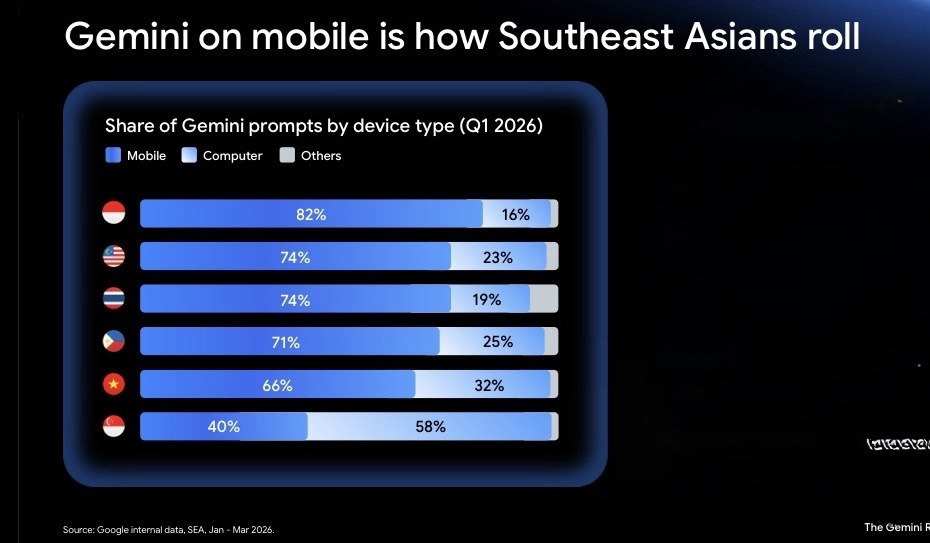
Across Southeast Asia, Google said adoption is being fueled by a young, mobile-first population. Nearly 70 percent of Gemini prompts are submitted in native languages, while almost three-fourths of interactions come through mobile devices, highlighting how AI is becoming part of everyday life.
For the Philippines, where the services sector remains a key economic pillar, the shift could prove especially significant. As companies increasingly embed AI into operations without replacing the human expertise that underpins customer service, the technology is evolving from a consumer convenience into a competitive business asset—one that could help strengthen the country’s position in the rapidly changing digital economy.