Energy policy craftsmen are actively working to fulfill President Ferdinand Marcos Jr.’s directive to eliminate system loss charges from monthly electricity bills, pursuing a sustained policy push aimed at lowering energy costs across the country. The initiative targets both technical losses inherent in power distribution and non-technical losses caused by electricity theft, alongside the value-added tax (VAT) currently applied to these unconsumed kilowatt-hours.
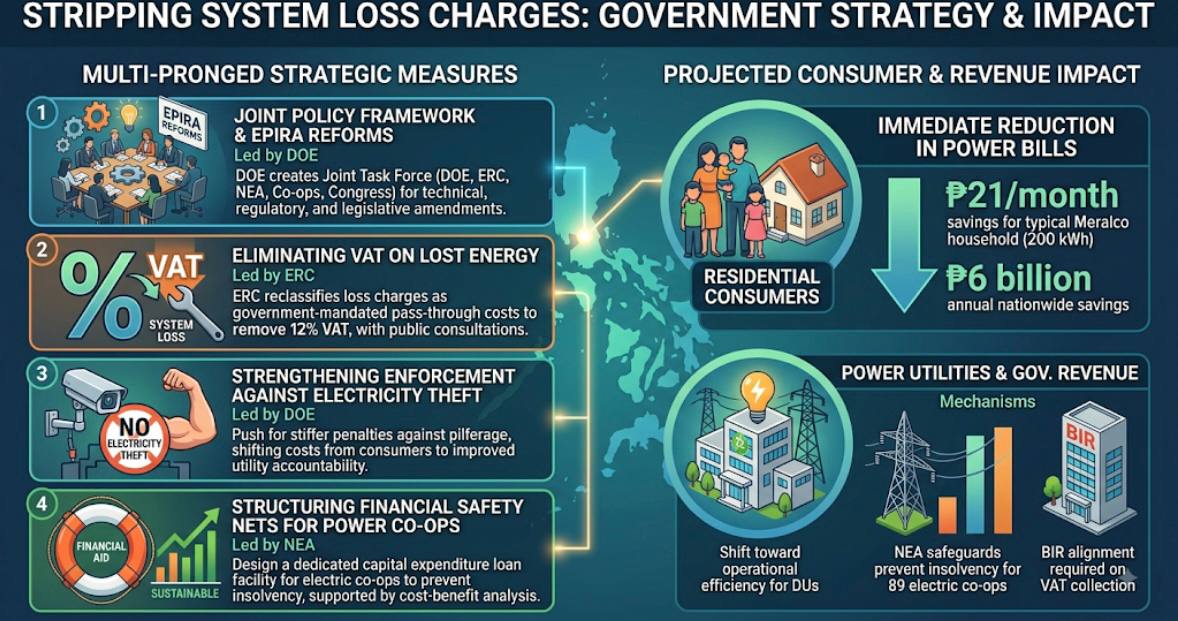
Energy Secretary Sharon Garin emphasized that consumers should not bear the financial burden of electricity that never reaches their homes. Under current rules, legitimate bill-payers absorb the costs of stolen electricity and line losses while paying an additional 12 percent VAT on top of those charges. To address this, the Department of Energy (DOE) has formed a Joint Task Force alongside the Energy Regulatory Commission (ERC), the National Electrification Administration (NEA), distribution utilities, electric cooperatives, and lawmakers to engineer necessary technical, regulatory, and legislative overhauls.
A primary focus of the government’s strategy involves cracking down on electricity theft, which damages grid infrastructure and artificially inflates bills for honest consumers. While legislative adjustments are being explored to penalize pilferage more heavily, immediate regulatory actions are already underway to dismantle the tax layer on lost power.
The ERC is advancing a draft resolution to reclassify the system loss charge as a government-mandated pass-through cost rather than gross receipts for power companies, effectively removing the 12 percent VAT on lost electricity once confirmed by the Bureau of Internal Revenue (BIR). ERC chairman Francis Saturnino Juan noted that applying VAT to undelivered energy contradicts the core nature of a consumption tax. Based on 2025 data, removing the 12 percent VAT on system losses across the board would yield approximately P6 billion in collective savings for consumers nationwide, with public consultations scheduled for August 25.
While the proposed reforms offer clear financial relief for residential households and commercial enterprises, power distributors face significant exposure. Technical losses stemming from physical resistance in power lines are unavoidable, while non-technical losses from illegal connections directly strain utility revenues if left unrecovered.
The NEA has raised concerns regarding the sudden, complete elimination of non-technical system loss cost recoveries, warning that it could severely impair the financial stability of electric cooperatives. NEA administrator Antonio Mariano Almeda revealed that prohibiting 25 percent of non-technical loss charges would result in financial losses for 62 cooperatives, a figure that jumps to 89 out of the country’s 121 cooperatives if 100 percent of the charge is abruptly removed. To prevent utility failures while maintaining consumer relief, the NEA is advocating for government-backed loan facilities to help cooperatives finance infrastructure upgrades and sustain capital expenditures.